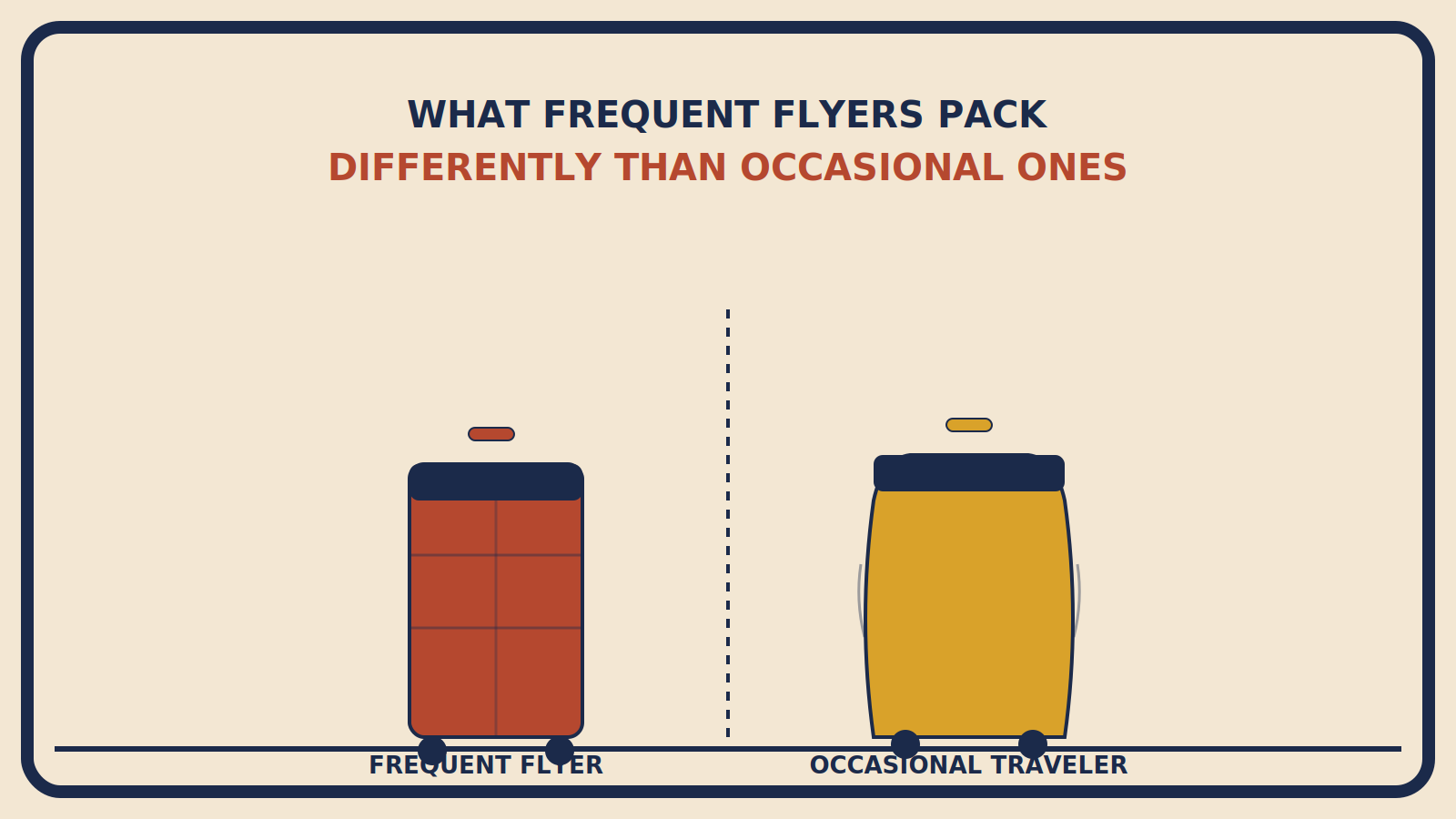
What Frequent Flyers Pack Differently Than Occasional Travelers
July 24, 2026 · 4 min read
Spend enough time in airports and the pattern becomes obvious: some travelers move through security and boarding calmly, nothing to repack at the gate, while others are still stuffing a jacket back in as the line moves. The difference isn't luck, it's a set of habits that only shows up after enough repetition, and most of them start before the trip even begins.
Quick Answer
- Pack less volume on instinct, prioritizing predictability over extra "just in case" space
- Choose structured interiors and compression over raw capacity for repeated use
- Keep a consistent internal layout: laptop, toiletries, and chargers in the same spot every time
- Separate dirty and clean clothes from day one, not as an afterthought
- The packing habit itself matters more than any single gear upgrade
Why Volume Is the Biggest Shift
The biggest shift is volume. Occasional travelers tend to pack for the version of the trip they're imagining: every outfit option, every "just in case" item. Frequent flyers pack less volume on instinct, because they've already lived through what happens when a bag is stuffed past comfortable: struggling to close it, digging past everything to find one item, paying attention to weight limits they've hit before. Predictability matters more to them than extra space, and that preference shows up directly in what actually makes it into the bag.
That instinct connects to being better prepared with better baggage equipment, not fancier necessarily, but more deliberate. Frequent flyers think in terms of repetition rather than a single trip: will this bag's structure, wheels, and handle still hold up after fifty more flights, not just this one. That long-term thinking pushes them toward structured interiors over raw capacity, compartments that reduce shifting, compression that keeps clothing stable, a consistent internal layout rather than one big open space. The payoff is routine: laptop in the same place every time, toiletries in the same section, chargers stored where they're expected to be. That consistency removes a surprising amount of decision fatigue on a travel day, especially when the day's already busy.
Why the Dirty/Clean Split Sticks
Separating dirty from clean clothes is another habit that shows up almost entirely in frequent flyers and almost never in occasional ones. Someone traveling once or twice a year doesn't have a system for this because they've never needed one, everything just goes back in together and gets sorted at home. Someone traveling weekly or biweekly has learned the hard way that mixing worn and clean items, even for a short trip, means smelling like the last trip on the next one. A dedicated pocket, cube, or bag for worn items isn't an extra step for a frequent flyer, it's just part of how the bag gets packed from day one.
Common Mistakes
People assume more capacity solves packing stress. In practice, structured interiors and a consistent internal layout do more for a travel day than raw size, since knowing exactly where the laptop, toiletries, and chargers live removes decision fatigue that extra space never actually fixes.
People assume better gear alone fixes an overstuffed bag. In practice, the volume habit matters more than any specific gear upgrade. A frequent flyer with an average suitcase who's disciplined about what goes in it will have an easier trip than an occasional traveler with premium luggage stuffed to capacity, because the packing habit does more work than the equipment itself.
People mix worn and clean clothes for the sake of one short trip. In practice, that habit catches up fast even on a quick trip, and a dedicated pocket or cube for worn items prevents it from becoming a problem in the first place.
None of this is really about owning better gear so much as it's about packing with the next fifty trips in mind instead of just this one. This piece on packing for a trip with laundry halfway through is a good next read specifically on the dirty-clothes-separation habit, since that's one of the easiest frequent-flyer patterns for an occasional traveler to adopt immediately.
An occasional traveler can borrow that experience without needing to accumulate it themselves the slow way, and that's exactly the kind of pattern JetKit is built to apply from the first trip rather than the fiftieth.
Frequently Asked Questions
Do frequent flyers pack less than occasional travelers?
Yes, and it's usually deliberate. Occasional travelers tend to pack for the version of the trip they're imagining, every outfit option, every just-in-case item. Frequent flyers pack less volume on instinct, because they've already lived through what happens when a bag is stuffed past comfortable.
Why do frequent flyers care about structured luggage?
They think in terms of repetition rather than a single trip, whether a bag's structure, wheels, and handle will still hold up after fifty more flights. That long-term thinking pushes them toward structured interiors over raw capacity, compartments that reduce shifting and a consistent internal layout rather than one big open space.
Why do frequent flyers separate dirty and clean clothes?
Someone traveling weekly or biweekly has learned that mixing worn and clean items, even for a short trip, means smelling like the last trip on the next one. A dedicated pocket, cube, or bag for worn items becomes part of how the bag gets packed from day one, not an extra step.
Does having better luggage matter more than packing habits?
Packing habits tend to matter more. A frequent flyer with an average suitcase who's disciplined about what goes in it will have an easier trip than an occasional traveler with premium luggage stuffed to capacity, since the packing habit does more of the actual work than the equipment itself.
Can an occasional traveler adopt frequent-flyer packing habits quickly?
Yes. Someone who travels constantly has already made the mistakes, an overstuffed bag that wouldn't zip, laundry that ruined a clean shirt, and adjusted permanently. An occasional traveler can borrow that experience directly rather than needing to accumulate it themselves the slow way.
JetKit is an AI app that builds your packing list automatically based on your closet and your trip.