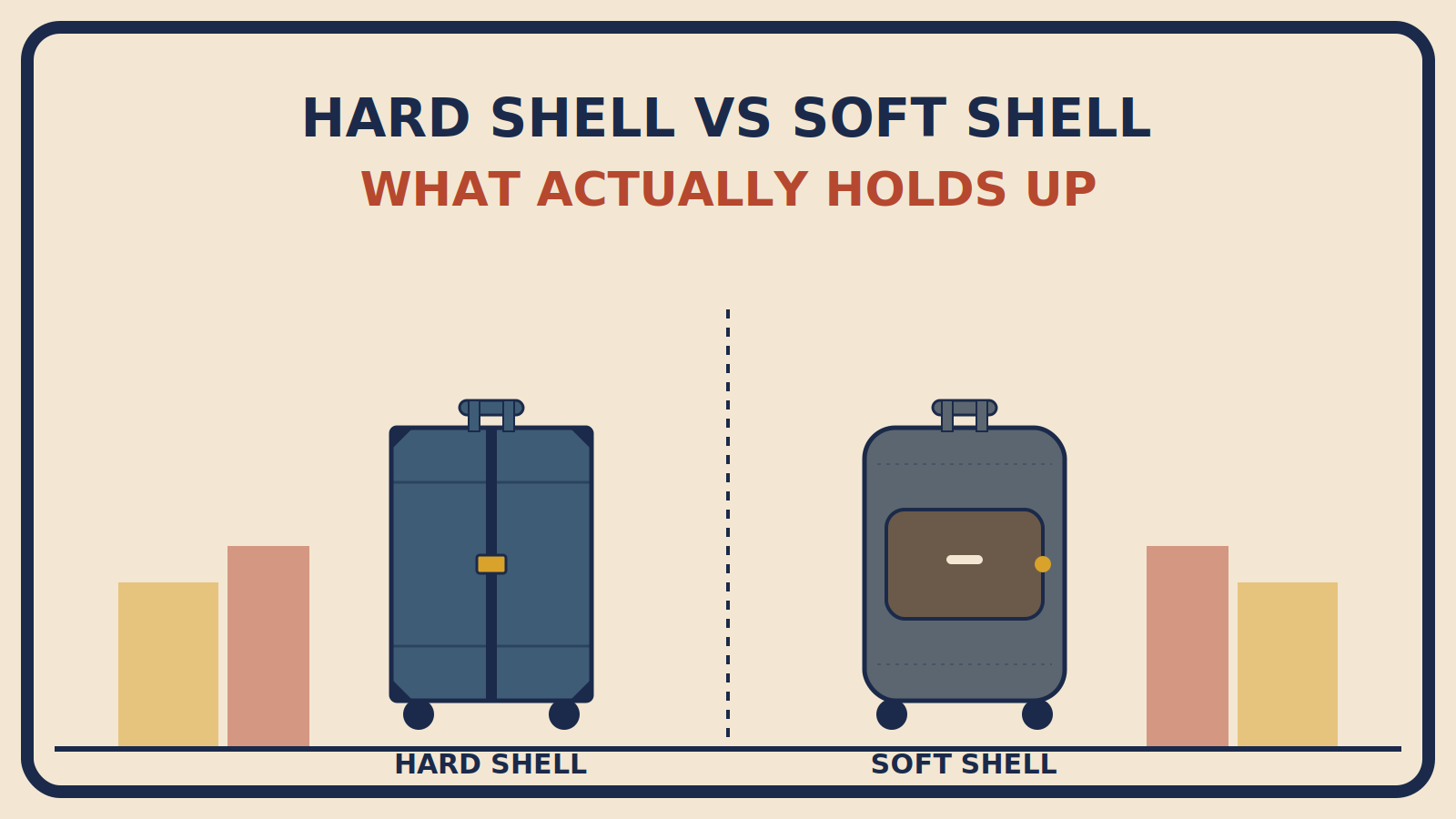
Hard-Shell vs. Soft-Shell Luggage: What Actually Holds Up
July 24, 2026 · 4 min read
Both have pros and cons, and the honest answer depends on how the bag actually travels: checked versus carry-on, budget airline versus full-service, fragile cargo versus a duffel-friendly packing style. Hard shell wins on crush and water resistance for checked bags, soft shell wins on weight and compressibility for carry-on-only travel.
Quick Answer
- Hard shell: better crush and water resistance, wins the durability argument for checked bags
- Soft shell: lighter (5-7 lbs vs 7-9 lbs empty), compresses into tight overhead bins
- Zipper locks are weak on either type; latch or drawbolt closures hold up better
- Some "soft shell" bags have rigid internal skeletons and behave like hard shell
- TSA can legally open any checked bag regardless of lock type
Why It Depends on How the Bag Travels
"It depends" only becomes useful once you know what it depends on, and the real answer changes based on how the bag is actually traveling. Hard shell wins the durability argument in the situations that matter most for checked luggage. Polycarbonate flexes under impact instead of cracking the way ABS plastic does at the corners, and a hard exterior sheds water and resists crushing through the rough handling a checked bag takes on international routes: thrown onto conveyors, stacked under other bags, left on a wet tarmac. Soft shell doesn't crack, but it has its own failure points: seams fray under repeated stress, and fabric tears if it's dragged across something abrasive. The upside is that a frayed seam is usually fixable with fabric glue or a stitch; a cracked shell generally isn't.
Weight tips the scale the other direction for carry-on-only travel. Hard shell carry-ons typically run 7 to 9 lbs empty against 5 to 7 lbs for a comparable soft shell, a 2 to 4 lb gap that matters a lot on a budget European or Asian carrier with a strict 22 lb carry-on cap. Every pound the bag itself weighs is a pound you don't get to pack. Soft shell also compresses to fit a tight overhead bin in a way a rigid clamshell can't, and its external pockets give you somewhere to stash a passport or charger without digging into the main compartment mid-flight.
Common Mistakes
People assume a locked zipper is real security. In practice, a ballpoint pen forced through the zipper coil can pop it open and let it re-close without leaving a mark, because zipper locks look secure but aren't much of a deterrent. Latch or drawbolt closures, common on aluminum and some premium hard shell lines, hold up far better.
People assume the "soft shell" label means all-fabric and fully compressible. In practice, some bags marketed as soft shell, like Away's Softside line and the Peak Design Roller Pro, actually have rigid internal skeletons that make them behave a lot more like hard shell luggage, because an internal frame changes both the weight and the crush resistance you're actually getting.
People assume a lock seals a checked bag shut. In practice, TSA can legally open anything regardless of lock type, because a lock is really about deterring casual tampering rather than sealing the bag shut on an international route.
The Real Numbers
- Hard shell carry-on weight: roughly 7 to 9 lbs empty
- Soft shell carry-on weight: roughly 5 to 7 lbs empty
- Weight gap: 2 to 4 lbs, meaningful against a strict 22 lb budget-carrier cap
None of this luggage math matters much if what's inside the bag doesn't actually get worn. A hard shell's fixed clamshell capacity forces some packing discipline by default, but the bigger lever is building a wardrobe worth the space it takes up in the first place. This piece on building a travel wardrobe you actually rewear is the other half of this decision: the right shell type only pays off if what's packed inside it earns its spot too.
Shell type solves the outside of the packing problem; JetKit is built to help solve the inside of it, sorting a closet down to the pieces actually worth carrying in whichever bag you land on.
Frequently Asked Questions
Is hard shell or soft shell luggage more durable?
It depends on the failure mode. Hard shell wins for checked luggage, since polycarbonate flexes under impact instead of cracking the way ABS plastic does, and a hard exterior sheds water and resists crushing better through rough handling. Soft shell doesn't crack, but seams can fray and fabric can tear if dragged across something abrasive.
Is hard shell or soft shell luggage lighter?
Soft shell is typically lighter. Hard shell carry-ons usually run 7 to 9 lbs empty against 5 to 7 lbs for a comparable soft shell, a gap that matters on a budget carrier with a strict 22 lb carry-on cap, since every pound the bag itself weighs is a pound you don't get to pack.
Are zipper locks on hard shell luggage actually secure?
Not particularly. A ballpoint pen forced through the zipper coil can pop it open and let it re-close without leaving a mark. Latch or drawbolt closures, common on aluminum and some premium hard shell lines, hold up far better than a zipper lock.
Can TSA open a locked checked bag?
Yes. On checked bags, TSA can legally open anything regardless of lock type, so a lock is really about deterring casual tampering, not sealing the bag shut.
Is a bag marketed as soft shell actually all fabric?
Not always. Some bags marketed as soft shell, including Away's Softside line and the Peak Design Roller Pro, actually have rigid internal skeletons that make them behave a lot more like hard shell luggage. Check for an internal frame before assuming you're getting the lighter, more compressible option.
JetKit is an AI app that builds your packing list automatically based on your closet and your trip.